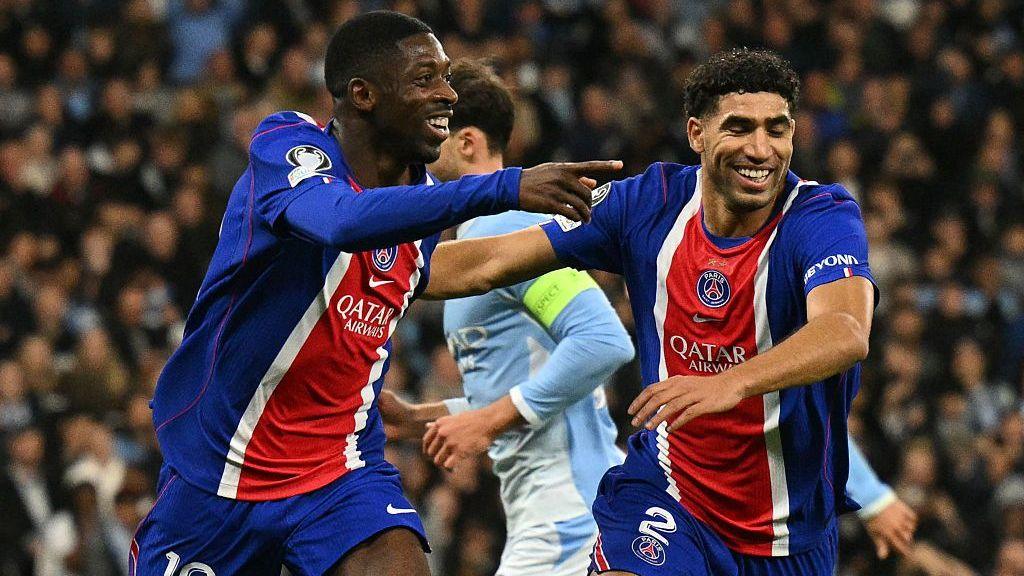
PSG on different level - but where do they rank against other great sides?
PSG are looking to win five pieces of silverware this season
Some find success sweet but fleeting, others spend years building to the pinnacle, and then there are those whose lasting glory evolves into a dynasty.
After tearing Manchester City apart in large spells of their 4-2 Champions League victory on Wednesday, Paris St-Germain look well on track to join the latter bracket.
The back-to-back European champions sliced through City with astonishing ease to take a 3-0 lead into half-time, and were still able to score another despite a spirited second-half fightback from the Premier League leaders.
After obliterating Inter Milan 5-0 in the 2025 final before squeezing past Arsenal on penalties in last season’s showpiece game, Luis Enrique’s side are aiming to win a third consecutive European crown.
They would be the fifth team to do so going back to 1956, and just the second in the Champions League era.
“This PSG team are on a different level,” Chris Sutton told BBC Radio 5 Live at half-time.
“They have just run all over Manchester City, who haven’t been able to string passes together. It’s been an absolute pummelling for Man City.”
To mark PSG’s latest display of attacking excellence, we’re looking at how the Parisians compare to those clubs who have enjoyed the most dominant eras in European competition.
Some will point out that football existed before the European Champion Clubs’ Cup began in 1955 - so apologies to Stan Cullis’ ‘world-champion’ Wolves outfit and the Mitropa Cup’s early Vienna heavyweights.
However, this top 10 debate is centred around winning European football’s grandest prize.
Paris St-Germain 2025-present
OK, straight in with the current champions, because this is a dynasty in the making.
Paris St-Germain are hoping to enter that bracket and the 4-2 win against Manchester City on Wednesday reminded the rest of Europe why you shouldn’t bet against them becoming continental champions for a third successive season.
PSG had a lacklustre start to the domestic season - they always do, don’t they? - but boast an uncanny ability to click into gear when it matters.
In Manchester, Luis Enrique’s side were at their unstoppable best. A ruthless blend of silky flicks and slick off-the-ball movement that saw a dazed City caught several frames behind.
“Unbelievable. PSG, what a team,” Sutton said.
“PSG’s press, I don’t think there’s another team that press with their intensity and ferocity.”
“This [City] is one of the best teams in the Premier League getting an absolutely roasting. This is them [PSG] having a slow start to the season. Heaven help everyone.”
The Parisians have been France’s most dominant force since the arrival of Qatar Sports Investments 15 years ago, but it took a change of approach for the holy grail of continental success to arrive.
“It’s the end of the glitter,” professed president Nasser Al-Khelaifi after years of lavish spending, ushering out the “flashy, bling-bling” era.
Instead, Enrique arrived in 2023 intent on building a coherent team. There was still significant investment, but on younger players who could be moulded by his philosophy and discipline while given room to flourish.
The result was two scintillating Champions League triumphs.
PSG thrashed Inter 5-0 to win their first Champions League in 2025
Talking of discipline. Helenio Herrera, the Argentine-born defender reared in Casablanca and Paris, had already traversed the dugouts of Atletico Madrid, Malaga, Deportivo and Barcelona before landing in Milan in 1960.
Herrera set about implementing his tactical brand of catenaccio at San Siro - one he insisted is misremembered as being more defensive than it actually was - and developing a ruthless counter-attacking team known as ‘Grande Inter’.
Winning the Scudetto in 1962-63, Herrera’s outfit became the first to lift the European Cup without losing a game the following season as Sandro Mazzola netted twice against Real Madrid in the final.
The Italians defended their crown the following year, despite losing their semi-final first leg at Anfield, edging Benfica in the final. It was the Portuguese giants’ second final defeat in three seasons. Some may say they were cursed…
Helenio Herrera won league titles with Inter, Barcelona and Atletico Madrid
The story goes that Bela Guttmann, fresh from winning the title with Porto, rocked up at Benfica, sacked all the senior players and promoted a talented bunch of youth team players instead.
Those promising youngsters won the title and then went all the way in the European Cup, beating Barcelona in the 1961 final.
That summer, a teenage Eusebio also joined Guttmann’s squad and steered them to European glory once more, seeing off Tottenham Hotspur in the semi-final before beating the great Real Madrid in the competition’s showpiece.
The legendary Ferenc Puskas scored a first-half hat-trick for the Spaniards, but Eusebio netted twice after the interval to seal Benfica a second successive crown.
Guttmann, buoyed by his remarkable success, left the club after not being offered the pay rise he felt he deserved and the curse the Hungarian boss supposedly put on the club - that they would not win another European trophy for 100 years - has become fable.
Whether the often-disputed story is true or not, the Lisbon giants have not landed another since - losing eight European finals, including three in the 1960s.
Eusebio scored 47 goals in the European Cup, including two in the 1962 final
Bayern Munich 1973-76
This was Bayern’s coming of age. Emerging from what was a fiercely competitive West German football scene, the Bavarians - promoted to the Bundesliga less than a decade earlier - were able to establish themselves as heavyweights in Europe.
With a backbone of goalkeeper Sepp Maier, marauding sweeper Franz Beckenbauer and the prolific Gerd Muller, and fresh off West Germany winning the 1974 World Cup, Bayern clinched three on the bounce, despite their domestic form dipping.
In fact, Beckenbauer said Bayern were past their peak after the first European Cup win over Atletico Madrid, but experience carried them through big games.
They beat Leeds in a controversial final in Paris, and then saw off Saint-Etienne the following year.
It took Bayern Munich 25 years to win Europe’s top prize again after doing it three times in a row during the 1970s
The teams above make the list for their trophy-winning spells. Pep Guardiola’s Barcelona were European champions twice in three years - losing to Jose Mourinho’s treble-winning Inter in between - but their dynasty was built on more than silverware.
Guardiola only spent four seasons at Barcelona, but it was an era-defining tenure, the Catalan giants pioneering a brand of football that would be celebrated and copied the world over.
Perhaps the real success of a team is in its legacy. Guardiola’s tiki-taka Barcelona built around La Masia graduates Xavi, Andres Iniesta, Sergio Busquets and, of course, Lionel Messi still resonates more than a decade since he left.
Pep Guardiola won the European Cup as a player with Barcelona and then twice as a manager, losing semi-finals to Inter and Chelsea either side of those triumphs
Where does this particular Milan dynasty start and end? It was fuelled, of course, by Silvio Berlusconi, who saved the club from bankruptcy in 1986 and appointed the up-and-coming Arrigo Sacchi as boss.
You could argue it continued until a Champions League final defeat by a young Ajax side in 1995. In between, the Rossoneri won back-to-back European Cups in 1989 and ‘90, then thrashed Cruyff’s Barcelona ‘Dream Team’ in 1994 after defeat in the final the previous season.
In fact, the only campaigns in which Milan did not reach the final were after their quarter-final second leg was abandoned because of floodlight failure while trailing Marseille in 1991. The Serie A giants’ refusal to re-enter the pitch for the final minutes of that one also led to them being banned the following year.
From Sacchi to Fabio Capello, through the brilliant Dutch trio of Ruud Gullit, Marco van Basten and Frank Rijkaard to homegrown stars Franco Baresi, Paolo Maldini and Alessandro Costacurta - the Italian core remaining from that 1989 triumph to the defeat by Ajax six years later - Milan were a phenomenal force.
Ruud Gullit and Marco van Basten both scored twice in a 4-0 victory over Steaua Bucharest as Milan won the first of back-to-back European Cups in 1989
In an era of English dominance on the continent, winning seven of eight European Cups between 1977 and 1984, Liverpool’s ‘Boot Room’ boys led the way.
The Reds won four of those, Nottingham Forest - who could argue they also deserve a spot on the list - went back-to-back and Aston Villa completed the haul.
Liverpool’s European pedigree really began when Bill Shankly’s side won the Uefa Cup in 1973, the Reds doing it again three years later under Shankly’s former assistant Bob Paisley.
Paisley was able to deliver the biggest prize of all the following season in Rome and, after Kenny Dalglish was brought in to replace Hamburg-bound Kevin Keegan, retained the European Cup at Wembley against Club Brugge in 1978 - the Scottish forward netting the winner.
Three years later, after Brian Clough took Forest to the top, Liverpool were European champions again when Alan Kennedy’s goal downed Real Madrid in Paris.
Perhaps most impressive is how the Anfield outfit were able to maintain that success through a series of managers. The line of succession from Shankly to Paisley then landed on Joe Fagan, who was in charge when they beat Roma - in Rome - in ‘84. That was before the Heysel disaster, and defeat by Juventus, the following year.
Liverpool won the European Cup four times between 1977 and 1984
Atletico fans look away now. Two finals in three years and twice Diego Simeone’s side ran into their Madrid rivals, losing in agonising fashion in both 2014 and 2016.
The second of those also sparked a three-year winning run for the most successful club in European Cup history.
Real Madrid’s formula was seemingly simple: construct a team of the world’s best players - spearheaded by Cristiano Ronaldo - and stick a legendary former star in charge.
Zinedine Zidane’s new-era galacticos just felt inevitable - they always found a way to win, becoming the first club in the Champions League era not only to retain the trophy but to lift three in a row.
After downing Atletico in the first of the three-peat, they beat Juventus and then Liverpool - the latter remembered for Gareth Bale’s cameo, Loris Karius’ blunders and Sergio Ramos leaving his mark on Mo Salah.
Similar to Guardiola’s Barcelona, the influence of this Ajax side was seen far beyond the trophy cabinet. The lineage of their philosophy - via Johan Cruyff - survives through several of the clubs on this list, from Catalonia to Paris.
Rinus Michels was the pioneer, taking Ajax from the threat of relegation to the most dominant side in Europe, losing the 1969 final to AC Milan but returning to win it for the first time two years later with their swaggering brand of Total Football.
Michels left for Barcelona on the back of that success, though Stefan Kovacs was able to retain the trophy the following year and then add a third successive European crown to Ajax’s pile with an impressive run that included knocking out Bayern Munich, Real Madrid and then Juventus in the final.
Cruyff, about to win the second of his three Ballon d’Ors, followed Michels to Barcelona and Ajax’s dynasty began to fall apart. The legacy, however, remains.
Ajax won three successive European Cups, having lost the final in 1969
When it comes to dominance, no one compares to the Real Madrid side who stormed to five successive European Cup triumphs after the competition began in 1955.
With the tournament in its infancy, it was perhaps not considered as imperative by certain nations compared to how Champions League participation dominates clubs’ thoughts today, but Real Madrid’s style and success helped to alter perceptions.
Alfredo Di Stefano, already a world star by the time Real beat Reims in the inaugural final, was an integral part of the Spanish giants’ success, the legendary Paco Gento likewise a stalwart (he also won a sixth European Cup in 1966).
Then, in 1958, Madrid added Hungarian genius Ferenc Puskas following his two-year ban for refusing to return to Budapest after the revolution in 1956.
Puskas was 31 when he joined, but scored 35 goals in 39 European Cup games for Real Madrid, including four in the 7-3 win over Frankfurt at Hampden in the 1960 final. Di Stefano grabbed the other three as Madrid made it five on the spin.
Real Madrid won the first five European Cups